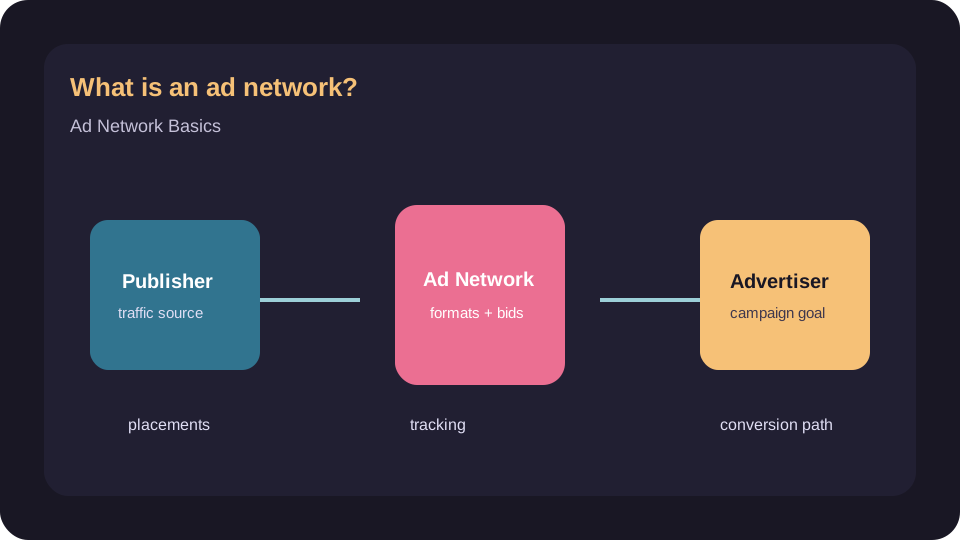
How to read this ad network explainer
This guide covers what is an ad network in plain terms, so you can act on it instead of guessing. You will see how formats, targeting, tracking and traffic quality fit together before any budget moves.
| Decision area | What to inspect | Why it matters |
|---|---|---|
| Fit | Whether the format, targeting and inventory match your goal | The format should match the real goal. |
| Measurement | Tracking, reporting, budget or payment rules | Bad measurement creates bad optimization. |
| Risk | User experience, compliance and stop rules | Traffic work needs controlled testing. |
Ad network definition
An ad network is a technology and sales intermediary that aggregates advertising space from publishers and makes it available to advertisers. Publishers use it to fill and monetize placements; advertisers use it to reach audiences across multiple sites or apps through one campaign interface.
The network is not the same as a single publisher. It organizes inventory, applies targeting and auction rules, serves ads, records delivery and usually handles billing and publisher payments.
How ad networks work
- A publisher integrates an ad tag, SDK or other placement code.
- The publisher describes eligible inventory and applies content or category controls.
- An advertiser creates a campaign with a creative, landing URL, targeting, bid and budget.
- When a page or app placement becomes available, the platform evaluates eligible campaigns.
- An auction or priority rule selects an ad and the ad server returns it.
- The platform records impressions, clicks and reported conversions.
- The advertiser is charged under the pricing model and the publisher receives revenue under the network's terms.
Who uses an advertising network?
Advertisers
Buy access to distributed inventory, target segments, control bids and compare campaign results without negotiating with every publisher separately.
Publishers
Offer available placements, set restrictions, monitor fill and revenue, and receive consolidated payments.
The network
Operates the marketplace and ad-serving layer, reviews participants and creatives, reports delivery, bills advertisers and pays publishers.
Common pricing models
- CPM: cost per thousand served impressions.
- CPC: cost per recorded click.
- CPA: cost per defined action, where available and trackable.
- Revenue share: the publisher receives an agreed share of monetization revenue.
An ad network's business model normally comes from the difference between advertiser spend and publisher payout, a disclosed fee, or a revenue share. The exact calculation and deductions should be checked in the current platform terms.
Types of ad networks (with examples)
Ad networks are not all the same. They differ by the inventory they aggregate, the ad formats they serve and the buyers they attract, so knowing the type helps you match a network to your goal.
- Premium and display networks aggregate banner and display inventory from established publishers — Google AdSense and Media.net are common examples.
- Vertical networks specialise in one niche such as finance, gaming or health, giving advertisers a concentrated, relevant audience.
- Performance and CPA networks optimise toward clicks or conversions rather than impressions, which suits affiliates and media buyers.
- Popunder, push and in-page push networks sell high-volume formats used for direct response and traffic arbitrage — OctoClick sits in this group.
- Native ad networks serve in-feed placements that match the look of the host page, with Taboola and Outbrain as large examples.
- Video and OTT networks deliver in-stream and connected-TV inventory.
Most publishers and advertisers use more than one network. Test a couple of types, compare source-level results, and keep the ones that deliver quality traffic for your specific offer.
Ad network vs ad exchange vs affiliate network
An ad network packages and manages publisher inventory for advertisers. An ad exchange is more commonly an auction marketplace used by multiple demand and supply platforms, often programmatically. An affiliate network tracks outcome-based partnerships between merchants and affiliates. These categories can overlap, so evaluate the actual buying model and reporting rather than relying only on the label.
Targeting and optimization features
Depending on the platform, targeting can include country or region, device, operating system, browser, language, time, carrier, interest, context, placement or source. Useful operational features include frequency caps, conversion postbacks, source-level reporting, allowlists and blocklists, automated rules, budget pacing and creative review status.
How to evaluate an ad network
- Confirm that its formats and inventory match your audience and objective.
- Read traffic, content, creative and prohibited-practice policies.
- Check reporting granularity, time zone, attribution and data export options.
- Understand deposits, fees, payout methods, thresholds and schedules.
- Look for invalid-traffic controls and a process for disputes.
- Test support responsiveness before committing a large budget or material inventory.
What an ad network cannot guarantee
A network can provide access, delivery and optimization tools; it cannot guarantee profit, conversions or a fixed publisher income. Results depend on inventory, competition, targeting, creative, landing page, audience and measurement. Start with a limited test and judge the platform from transparent, source-level evidence.
How do ad networks make money?
An ad network earns the difference between what advertisers pay and what it passes on to publishers. That difference is usually called the take rate or revenue share. If an advertiser pays $2.00 for a thousand popunder impressions and the publisher receives $1.40, the network keeps $0.60 to cover ad serving, fraud filtering, sales, support and profit.
| Revenue source | How it works | What it means for you |
|---|---|---|
| Revenue share | Network keeps a percentage of every impression or click it sells | Publishers should compare net payouts, not gross bids |
| Minimum bids and floors | Network sets floor prices per GEO and format | Advertisers in cheap GEOs may still face a minimum CPM or CPC |
| Premium services | Managed campaigns, direct deals or priority placements | Useful at scale; rarely needed for a first test |
Knowing the business model explains most network behaviour: why sales teams push volume, why floors exist and why reporting quality differs between platforms.
Ad network terms you will meet in the dashboard
| Term | Meaning |
|---|---|
| Run of network (RON) | Your ads can appear on any site in the network that matches your targeting, without choosing specific placements |
| Zone / placement | A specific ad slot on a publisher site; advertisers can include or exclude zones by ID |
| Ad network ID | The identifier a network assigns to your account, site or zone; used in tags, ads.txt lines and postbacks |
| Ad network integration | Adding the network's tag, script or SDK to a site or app so it can serve ads |
| Ad network API | Programmatic access to campaigns and statistics, used for automated bidding and reporting |
| Postback / S2S tracking | A server-to-server call that reports a conversion back to the network or your tracker |
| eCPM | Effective revenue or cost per thousand impressions, whatever the pricing model |
If a network's dashboard hides zone IDs, has no API or cannot accept postbacks, optimisation becomes guesswork. These features matter more than a long list of formats.
Ad network in digital marketing: where it fits
In a digital marketing plan an ad network is a paid distribution channel. Search ads capture existing demand, social ads target people by profile, and ad networks buy attention across thousands of independent websites. They are strongest for reach and testing offers in many GEOs, and weakest for high-intent buyers who are actively searching for a product.
- Use search when people already look for your product.
- Use social platforms when interest and demographic targeting matter most.
- Use ad networks (popunder, push, native, banner, video) for volume, wide GEO coverage and low-cost testing.
Thinking about building one instead of using one? Read how to start an ad network first — it is a much bigger project than it looks.
Ready to compare options?
Open the tracked provider page after matching the offer to what is an ad network requirements.