What this traffic-buying guide covers
Here is a practical look at how to buy traffic, focused on the decisions that change results. The sections below become checks you can run before you commit money.
| Decision area | What to inspect | Why it matters |
|---|---|---|
| Fit | Whether the format, targeting and inventory match your goal | The format should match the real goal. |
| Measurement | Tracking, reporting, budget or payment rules | Bad measurement creates bad optimization. |
| Risk | User experience, compliance and stop rules | Traffic work needs controlled testing. |
How buying click traffic works
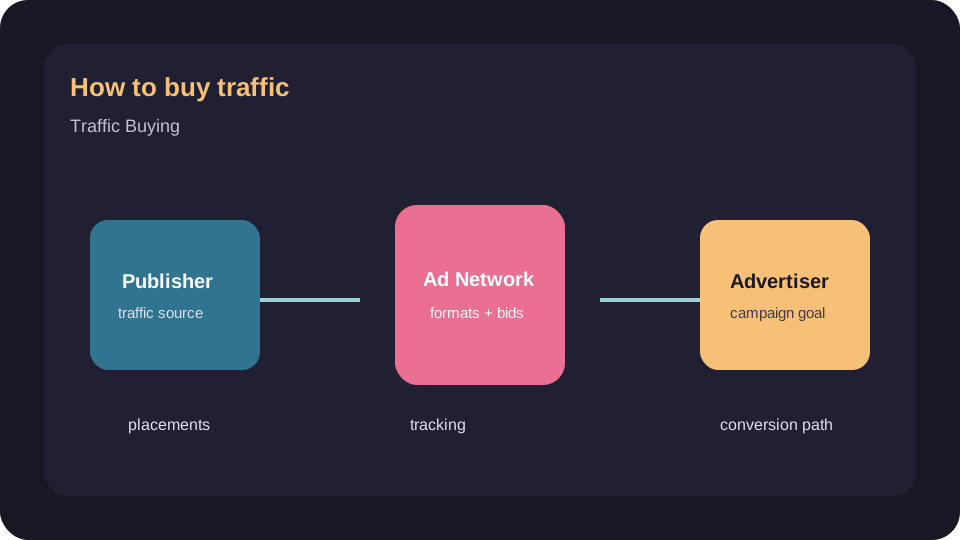
When you buy click traffic, you pay an ad network to send visitors from publisher placements to your landing page. The network supplies inventory; you choose a format, GEO, device, bid and budget. In a CPC campaign you pay for recorded clicks. In CPM campaigns you buy impressions, so the effective cost per click depends on click-through rate.
Paid traffic is not a shortcut to guaranteed customers. The useful goal is to purchase a controlled sample of relevant visits, measure what those visitors do, and keep only the sources that support the campaign objective.
CPC, PPC and CPM: which buying model fits?
CPC or PPC traffic
Choose cost per click when the first test needs predictable visit volume. Confirm how the network defines and filters a billable click.
CPM traffic
Choose cost per thousand impressions when creative performance is proven and you can optimize CTR. Weak creatives can make the effective CPC expensive.
CPA optimization
Use conversion data as the decision metric even when the network bills by CPC or CPM. A cheap click that never converts is not cheap traffic.
Where to buy click traffic
Buy through an ad network or another source that clearly documents inventory, targeting, reporting, content rules and traffic-quality controls. Before depositing funds, check available GEOs, device and operating-system targeting, source or zone reports, minimum bids, budget caps, conversion postbacks and exclusion tools. A network is a poor fit when it cannot show which placements generated the visits.
Seven-step traffic buying plan
- Define one conversion. Pick a sale, qualified lead, registration or another event with a reliable value.
- Prepare tracking. Pass campaign, creative and source IDs into analytics; test the conversion pixel or server-to-server postback.
- Match the landing page. Keep the promise, audience and device experience consistent from ad to page.
- Choose a narrow first segment. Start with one format, a small GEO group and a limited device mix.
- Set a test budget and stop rule. Decide the maximum spend per source before launch.
- Collect enough data. Avoid judging a placement from one click, but do not let obvious anomalies consume the budget.
- Exclude, refine and retest. Separate promising sources into focused campaigns and change one major variable at a time.
How to evaluate traffic quality
Review more than sessions. Compare source-level conversion rate, engaged visits, repeat patterns, time to conversion, device consistency and invalid-traffic alerts. Sudden click bursts, impossible engagement, mismatched GEOs or many visits with identical behavior deserve investigation. Use network reports together with first-party analytics; neither view is sufficient alone.
Budget example
If the maximum acceptable acquisition cost is $20 and the landing page converts 2% of qualified visitors, the break-even click value is about $0.40 before other costs (20 × 0.02). Treat that as a ceiling, not a recommended bid. Begin below it, reserve budget for multiple creatives and placements, and base scaling on confirmed conversions rather than CTR alone.
Pre-launch checklist
- Conversion event fires once and records the correct value.
- Campaign, creative, GEO, device and source IDs reach the analytics report.
- Daily and total budgets have hard limits.
- The landing page is fast, mobile-ready and compliant with network rules.
- At least two meaningfully different creatives are ready.
- Pause rules are written for spend, quality and conversion thresholds.
Common traffic purchasing mistakes
Avoid buying the largest package before source-level tracking works, mixing many GEOs in one test, optimizing only for cheap CPC, changing bid and creative simultaneously, or scaling from a handful of conversions. The right traffic source is the one that produces measurable business outcomes within your risk limit—not simply the most clicks.
Buying click traffic by zone and placement
Most self-serve networks report results by zone — a single ad placement on a single site. Zone-level data is the most powerful optimisation tool a traffic buyer has.
- Launch run of network with tight GEO, device and OS targeting.
- After enough spend for each zone to show a pattern, sort zones by cost per conversion.
- Blacklist zones that spend without converting; whitelist zones that convert below target.
- Move whitelisted zones into a separate campaign with a higher bid to win more of that inventory.
- Keep a small run-of-network campaign alive to discover new good zones.
Write down your stop rule before launch, for example “pause any zone that spends 2× the target CPA with no conversion”. Without it, cheap clicks quietly add up.
How to buy pop traffic
Popunder traffic is sold mostly on CPM and arrives as a full-page visit. It suits offers that convert on a single landing page: software installs, sweepstakes, utilities, some e-commerce. Practical rules:
- Use a lightweight landing page that loads in under two seconds on mobile — see landing pages for paid traffic.
- Set a frequency cap (for example one view per user per 24 hours) to avoid paying repeatedly for the same visitor.
- Start with one GEO and one device type so results are readable.
- Read the popunder campaign guide for bidding and creative-free testing.
What buying traffic really costs
| Metric | Formula | Example |
|---|---|---|
| Cost per click (from CPM) | CPM ÷ (CTR × 1,000) | $1.50 CPM at 0.5% CTR ≈ $0.30 per click |
| Cost per acquisition | Spend ÷ conversions | $150 ÷ 12 = $12.50 |
| Break-even CPA | Payout per conversion × margin target | $20 payout at 30% margin → max CPA $14 |
| Test budget | Target CPA × 20–30 conversions | $14 × 25 ≈ $350 per offer/GEO |
The example figures are for illustration only. The point is to know your break-even CPA before you buy a single click, then judge every source against it.
Buy PPC traffic: search vs ad networks
“PPC traffic” covers two different products. Search PPC (Google, Bing) sells clicks from people typing a query — expensive but high intent. Ad-network PPC sells clicks from banners, native widgets and push notifications on publisher sites — cheaper and broader, but the user was not looking for you. Ad-network PPC works when your landing page creates the interest; search PPC works when the interest already exists.
Ready to compare options?
Open the tracked provider page after matching the offer to how to buy traffic requirements.