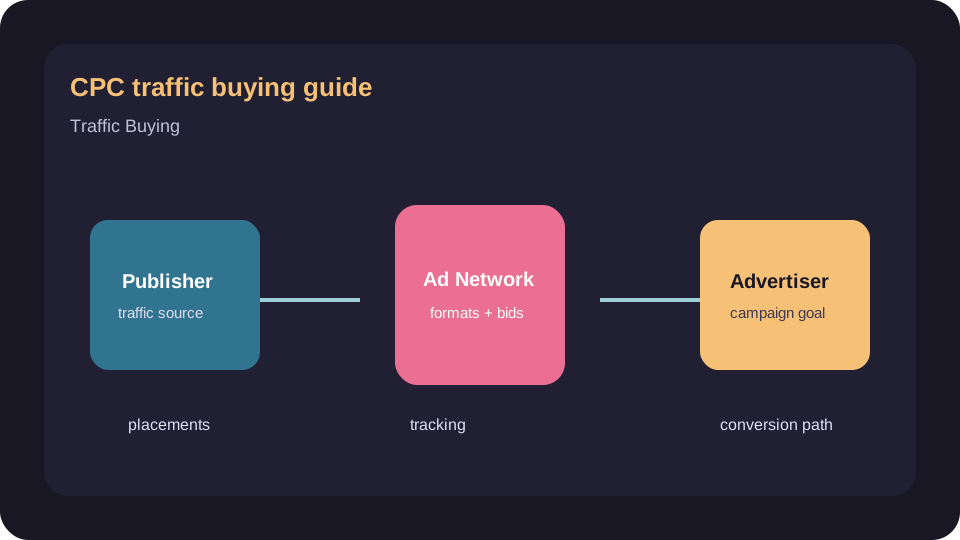
What buying traffic on CPC means
Cost-per-click buying means you pay only when someone clicks your ad, not for the impressions that led there. That shifts the impression risk onto the supply side and gives you cost certainty per click, which is why CPC is a comfortable starting point when you are still learning which creatives and audiences work. The catch is that a click is not a customer, so everything after the click still has to earn its keep.
Where to buy click traffic
Click traffic comes from self-serve ad networks running pop, push, in-page push and native inventory, from search and social platforms, and from native discovery networks. For performance offers on a modest budget, self-serve networks are the usual entry point because they accept verticals mainstream platforms reject and let you test cheaply. The right source is the one whose GEO and format match your offer.
| Step | Action |
|---|---|
| 1 | Pick one offer and the GEO where it is proven |
| 2 | Choose a format that matches the offer |
| 3 | Set a test budget and a written stop rule |
| 4 | Install click and conversion tracking with postbacks |
| 5 | Launch two or three creatives, then optimise by source |
Judging click quality
Cheap clicks are only cheap if they convert. Watch conversion rate, time on page and source-level results, and treat any source that spends without converting as a cost to cut, not a mystery to admire. A slightly higher click price from a source that converts almost always beats a rock-bottom price that does not.
From test to channel
Once a creative and source combination converts within your target cost, scale by widening GEO and adding creatives rather than raising bids blindly. Keep the tracking consistent so every new source is judged the same way, and revisit the numbers whenever volume changes, because click economics rarely stay identical as a campaign grows.
Ready to compare options?
Open the tracked provider page after matching the offer to CPC traffic buying requirements.