How to approach this
Here is a practical look at how to monetize website traffic, focused on the decisions that change results. Expect honest checks on measurement, targeting and risk instead of inflated claims.
| Decision area | What to inspect | Why it matters |
|---|---|---|
| Fit | Whether the format, targeting and inventory match your goal | The format should match the real goal. |
| Measurement | Tracking, reporting, budget or payment rules | Bad measurement creates bad optimization. |
| Risk | User experience, compliance and stop rules | Traffic work needs controlled testing. |
Choose a monetization model that matches visitor intent
Website traffic monetization means turning audience attention or actions into revenue. The best method depends on why visitors arrive, what they trust the site to provide, geography, device mix, session depth and purchase intent. Traffic volume alone does not determine earnings.
Advertising
Display, native, in-page push and other placements can monetize broad informational traffic through CPM, CPC or revenue-share arrangements.
Affiliate offers
Relevant recommendations can earn a commission after a tracked sale or lead. Clear disclosure and genuine editorial fit are essential.
Direct revenue
Subscriptions, memberships, digital products, services and sponsorships can work when the audience has a specific recurring need.
Ways to monetize web traffic
- Ad networks: scalable access to advertiser demand with relatively simple integration.
- Direct ad sales: more control and potentially higher rates, but more sales and operations work.
- Affiliate marketing: performance-based revenue from relevant commercial actions.
- Sponsored content: fixed-fee partnerships that require prominent disclosure and editorial boundaries.
- Subscriptions or memberships: recurring reader revenue for distinctive, ongoing value.
- Products, services or leads: monetize expertise or high-intent visits directly.
- Donations: audience support for useful independent work.
How ad-network monetization works
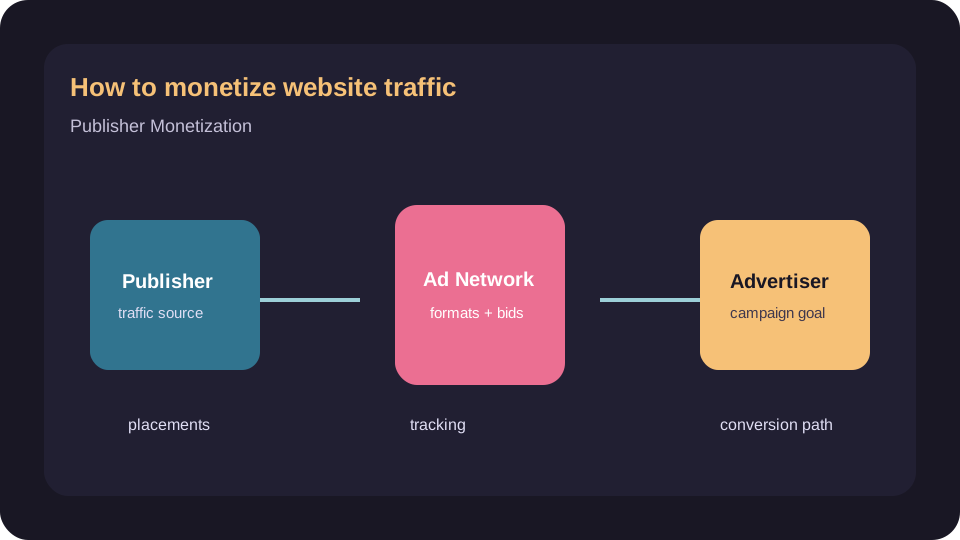
The publisher creates placements and adds the network's code or approved integration. Eligible ads compete or are selected for each opportunity. The network reports impressions, clicks and revenue, then pays according to its calculation, threshold and schedule. Before integrating, confirm allowed content, ad behavior, geographic coverage, deductions, payment method and invalid-traffic policy.
Measure revenue without losing the audience
Track revenue per thousand sessions or pageviews alongside viewability, page speed, engagement, return visits and complaints. A placement that raises short-term RPM but slows pages, obscures content or drives readers away can reduce total long-term value. Compare results by page type, GEO and device rather than applying one layout everywhere.
Publisher testing plan
- Baseline traffic, speed, engagement and existing revenue.
- Select one monetization method and one page group.
- Define placement rules and a user-experience guardrail.
- Run the test long enough to cover normal traffic variation.
- Compare revenue with engagement, performance and quality signals.
- Keep, revise or remove the test; document the decision.
Monetization without AdSense
A site can monetize without any single platform. Alternatives include other ad networks, direct sponsorships, affiliate partnerships, paid content, memberships, products and services. Avoid making a site's cash flow dependent on one provider: payment delays, policy changes, demand shifts and account reviews can occur.
Traffic quality and policy safety
Networks and advertisers care about valid human attention. Do not purchase misleading or automated traffic to inflate ad revenue, encourage accidental clicks, hide ads, or place creatives where users cannot distinguish them from controls. Maintain consent and privacy disclosures appropriate to the site and visitor locations, and keep records of traffic sources.
Publisher checklist before scaling
- Ads are visibly distinct from editorial content and controls.
- Mobile layout, Core Web Vitals and accessibility remain usable.
- Revenue can be segmented by placement, page group, GEO and device.
- Payment threshold, schedule, verification and deductions are understood.
- A fallback exists if demand falls or a provider pauses the account.
- Affiliate and sponsored relationships are disclosed clearly.
A practical monetization portfolio
Start with the least disruptive method that fits current intent, then diversify. Informational pages may support restrained ads; comparison pages may support disclosed affiliate links; loyal readers may value a paid product or membership. The strongest portfolio makes each revenue method useful to the reader instead of treating every visit as interchangeable inventory.
Website traffic monetization: a worked revenue estimate
Before choosing a network, estimate what your traffic can realistically earn. The basic formula is simple:
Monthly revenue = monthly pageviews ÷ 1,000 × ads per page × eCPM × fill rate
| Input | Example value | Where to get it |
|---|---|---|
| Monthly pageviews | 120,000 | Your analytics |
| Ads per page | 1.5 | Your layout (be honest about what users tolerate) |
| eCPM | $1.20 | Network stats for your GEO mix after a test |
| Fill rate | 85% | Network report: paid impressions ÷ requests |
| Estimated revenue | ≈ $184 / month | 120 × 1.5 × 1.20 × 0.85 |
The example numbers are illustrative only. Your eCPM depends mostly on visitor GEO, device and format; a site with mostly tier-1 traffic can earn several times more per thousand impressions than one with mostly tier-3 visitors.
How to monetize tier-1 and niche traffic
Tier-1 traffic (US, UK, Canada, Australia, Western Europe) attracts the most advertiser demand. Protect it: limit aggressive formats, keep pages fast and prefer formats that do not hurt return visits, such as native and in-page push.
Niche traffic (gaming, software, finance, members areas, entertainment) often converts better with targeted offers than with generic display. Affiliate links, sponsored content and direct deals can beat network ads when your audience is narrow and loyal.
| Traffic profile | Formats to try first | Watch-out |
|---|---|---|
| Tier-1, content site | Native, display, in-page push | Popunders can hurt returning visitors |
| Tier-2/3, high volume | Popunder, in-page push | Low eCPM; frequency caps matter |
| Niche / members area | Native, direct link, sponsor deals | Check network content policies |
| E-commerce site | Affiliate and retail media, light native | Ads should not distract from checkout |
Direct link monetization: best practices
A direct link (smartlink) is a URL that sends visitors to an offer chosen by the network. It needs no ad slot, which makes it useful for social traffic, download buttons and exit points.
- Place direct links where the user expects to leave the page, not on core navigation.
- Label them honestly — misleading buttons get accounts banned and destroy trust.
- Track them as a separate source so you can compare revenue per visitor with on-page ads.
- Stop if bounce rate or complaints rise; short-term revenue is not worth losing the audience.
Traffic monetization platforms for website publishers
Most publishers end up combining two or three platforms: one display or native network for main pages, one performance network for remaining inventory, and affiliate programmes for high-intent pages. See the publisher ad network guide for how to compare them and monetization without AdSense if your site was rejected.
Ready to compare options?
Open the tracked provider page after matching the offer to monetize website traffic requirements.